 Database Migration
Amazon · Devices & Services FinTech · 2025
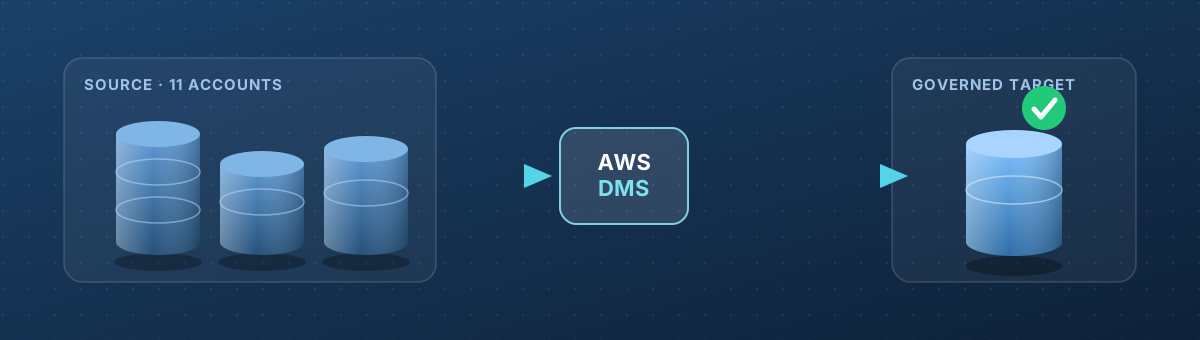
Designed and led a large-scale, standardized migration platform that consolidated production data across Amazon's FinTech organization — moving 9 relational database clusters and 2 data warehouse clusters across 11 AWS accounts and multiple regions into a governed target environment. Built on AWS Database Migration Service (DMS) with full-load plus change-data-capture (CDC) replication for continuous, low-downtime cutover, backed by automated row-level data validation to guarantee parity between source and target.
9RDS clusters
2Data warehouses
11AWS accounts
MultiRegions
Source DBs (9 RDS · 2 DW)
→
AWS DMS (full-load + CDC)
→
Data validation
→
Governed target (multi-region)
Highlights
- Migrated a large-scale production estate — 9 relational database clusters and 2 data warehouse clusters across 11 AWS accounts and multiple regions.
- Replaced ad-hoc, manual migrations with a repeatable, auditable framework for cross-account, cross-region data movement.
- Used AWS DMS full-load + CDC to replicate continuously and keep cutover downtime minimal.
- Automated row-level data validation to verify source-to-target parity and catch drift before cutover.
- Added CloudWatch alarms to monitor replication lag and task health for production reliability.
AWS DMS · Amazon RDS · Redshift · Multi-Account · Multi-Region · CDC · CloudWatch · Python
 Performance & Cost
Amazon · Marketing Measurement
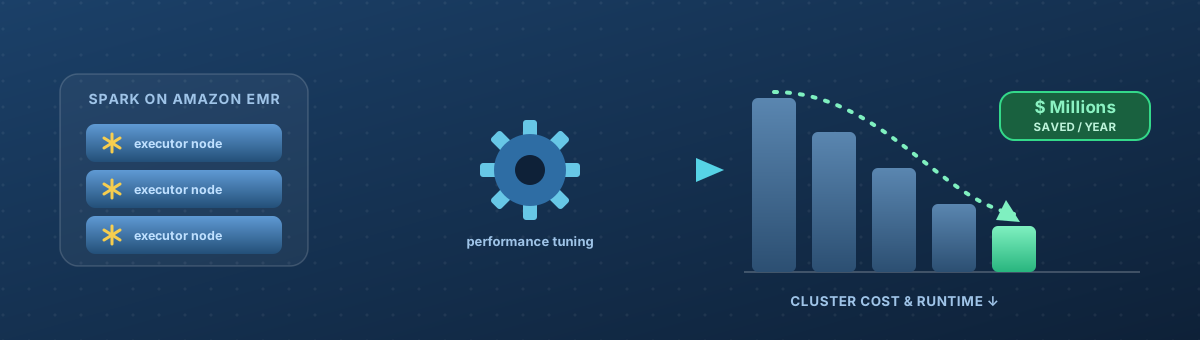
Diagnosed and tuned large-scale Apache Spark jobs running on Amazon EMR that were slow and expensive at scale. By profiling the workloads and fixing the real bottlenecks — data skew, excessive shuffles, suboptimal partitioning, and executor/memory configuration — and right-sizing the EMR clusters, I dramatically cut job runtime and compute cost, saving millions of dollars in annual savings while reducing software delivery latency.
$ MillionsSaved per year
Sparkon Amazon EMR
↓ Cost& runtime
Profile Spark jobs
→
Find bottlenecks (skew · shuffle · partitions)
→
Tune (partitioning · caching · executors)
→
Right-size EMR
→
Lower cost & runtime
Highlights
- Profiled large-scale Spark jobs to pinpoint bottlenecks — data skew, excessive shuffles, suboptimal partitioning, and memory pressure.
- Tuned partitioning, caching/persistence, join strategies, and executor/memory configuration for major throughput gains.
- Right-sized Amazon EMR clusters (instance types, autoscaling, spot) to cut compute cost.
- Reduced job runtime and cluster cost — delivering millions of dollars in annual savings.
- Improved pipeline reliability and reduced software delivery latency.
Apache Spark · PySpark · Amazon EMR · Performance Tuning · Cost Optimization · Partitioning · Data Skew · YARN
 Software Engineering (ML Platform)
Amazon · ML Infrastructure
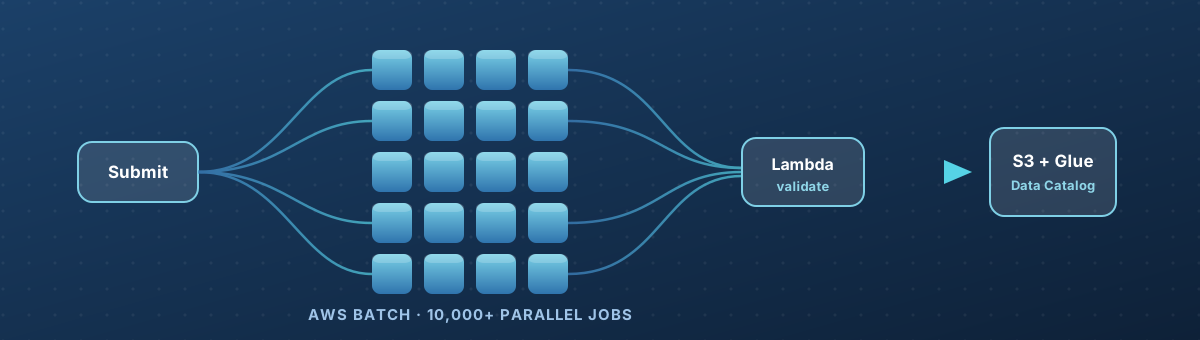
Built an MLOps platform that gave the data science team a self-serve lab to train models and run experiments at scale. AWS Batch orchestrates parallel model training and experiment execution; AWS Lambda validates results; S3 + AWS Glue Data Catalog store and catalog historical experiment results so they stay queryable for analysis; and CloudWatch alarms keep the platform reliable in production. The lab supports 10,000+ parallel experiments and model executions.
10,000+Parallel experiments
ParallelModel training & exec
Self-serveData-science lab
Experiment submissions
→
AWS Batch (parallel train + exec)
→
Lambda validation
→
S3 + Glue Data Catalog (history)
Highlights
- Delivered a self-serve experimentation lab enabling the data science team to run 10,000+ parallel experiments and model executions.
- Used AWS Batch to fan out model training and experiment execution across many compute jobs in parallel.
- Validated experiment outputs automatically with AWS Lambda before results were persisted.
- Stored and cataloged historical experiment results in S3 + AWS Glue Data Catalog, keeping them queryable for analysis.
- Monitored platform health with CloudWatch alarms for production reliability.
AWS Batch · AWS Lambda · S3 · AWS Glue · Data Catalog · CloudWatch · Python · MLOps
 Agentic AI
Independent Project · 2026
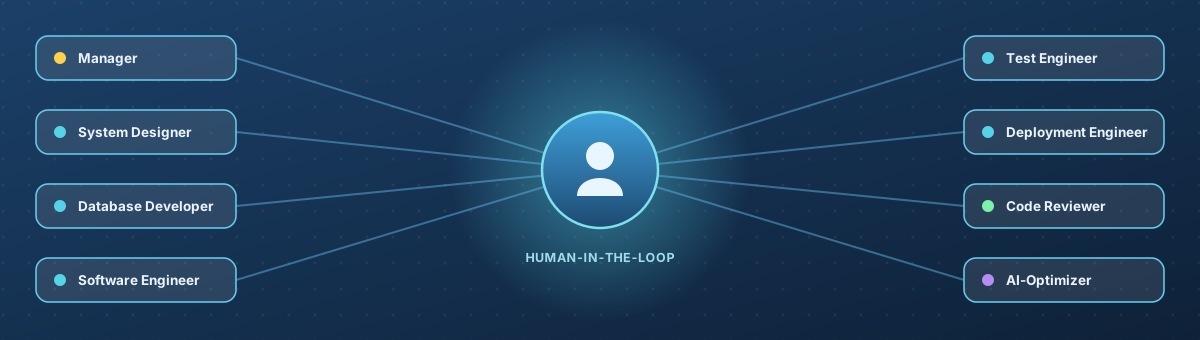
A multi-agent harness, powered by Claude Code, where a specialized crew of eight AI agents builds software collaboratively end to end — a manager that assigns and organizes the work, plus a system designer, database developer, software engineer, test engineer, deployment engineer, code reviewer, and an AI-optimizer that tunes the crew after every iteration. Each agent is scoped to least-privilege permissions and a curated set of MCP tools. The crew runs roughly 99% of day-to-day development, design, testing, and deployment autonomously, while I stay the human-in-the-loop — monitoring the harness and reviewing code and design at critical checkpoints.
~99%Day-to-day automation
8Specialized agents
Human-in-loopReview & oversight
The Crew
- Manager — assigns tasks and organizes the workflow across the crew.
- System Designer — designs new projects and features for existing ones.
- Database Developer — data modeling and SQL development.
- Software Engineer — API development and software product build-out.
- Test Engineer — writes unit and integration tests for every engineer's work.
- Deployment Engineer — AWS cloud deployment and AWS CDK infrastructure.
- Code Reviewer — reviews every developer's code and raises CRs / PRs.
- AI-Optimizer — after each iteration, tunes the agents and builds new MCP tools.
Manager assigns
→
Design · Build · Test · Deploy
→
Code review (PR/CR)
→
Human approval
→
AI-Optimizer tunes agents + MCPs
Highlights
- Orchestrated a crew of 8 specialized Claude Code agents spanning management, design, database, software, test, deployment, code review, and AI optimization.
- A manager agent assigns and organizes work; engineers hand off across design → build → test → deploy.
- Built-in code review on every change (raising CRs / PRs) before it ships.
- An AI-optimizer tunes the agents and creates new MCP tools after each iteration, so the crew improves over time.
- Scoped each agent to least-privilege permissions and a curated set of MCP tools.
- I stay the human-in-the-loop — monitoring the harness and approving code and design at critical checkpoints.
Claude Code · Multi-Agent Systems · MCP · Agentic AI · LLM Orchestration · Code Review · CI/CD · Python